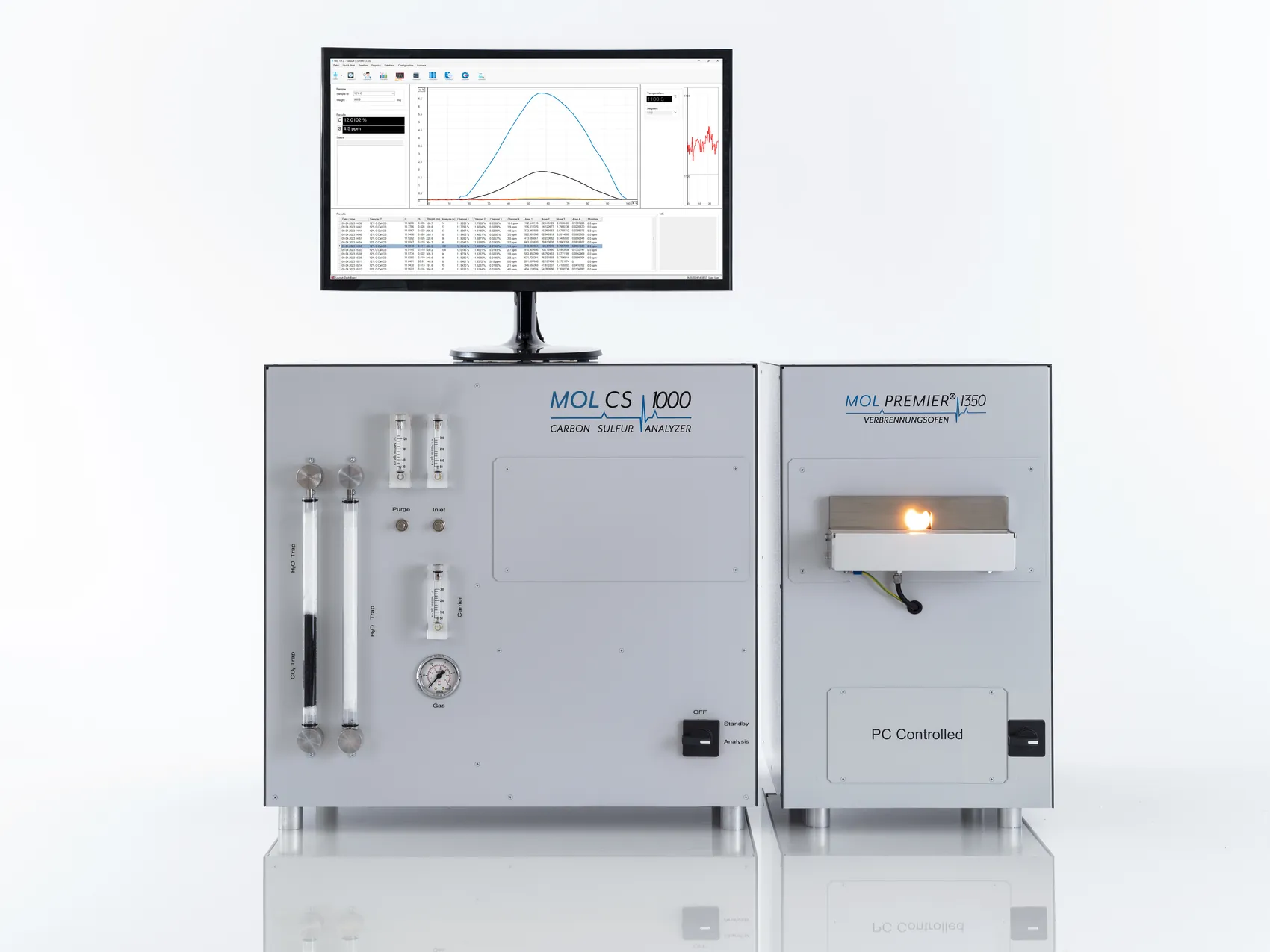
Mol elemental analyzer, front view

Elemental analyzer

Mol CS1000

Simultaneous determination of total carbon and total sulfur in solid samples. Separate cabinets, up to four independent NDIR detectors, automatic drift correction.

Overview

The versatile standard for C and S.

The Mol CS1000 is a modern, versatile and reliable elemental analyzer for the simultaneous determination of total carbon (TC) and total sulfur (TS) in predominantly organic solids such as coal, coke, oil, ash, catalysts, limestone, gypsum, soils, rubber and waste – as well as in some liquid materials.

It further enables the determination of environmental parameters such as TOC and TIC. Depending on the configuration, up to four independent, selective wide-range infrared detectors are used. Automatic measuring range adjustment covers concentrations from a few ppm to high percentages without operator intervention.

The distinctive feature is the external furnace. While the CS1500 integrates the furnace and is therefore exceptionally compact, the CS1000 works with standalone Mol Premier® furnaces. Mol Multi Furnace technology connects up to three furnaces to one analyzer. If you measure coal today and add cement and trace carbon tomorrow, you extend the system instead of buying a second instrument.

Up to three furnaces on one instrument
Mol Multi Furnace: two combustion furnaces for different matrices and a pre-heating furnace on a single analyzer. Retrofittable as your needs grow.
Concentration-independent
Simultaneous determination of carbon and sulfur across a wide range – from traces to high percentages.
Mol ADC drift correction
Continuously monitors the infrared signals and corrects drift automatically. An integral part of the instrument.
Mol EFC flow control
Fully electronic flow control for maximum reliability and stability across long measurement series.
Mechanical choke valves
Two maintenance-free, durable choke valves for purge and inlet gas flow. Once set, the setting stays fixed.
Retrofittable detectors
The Mol NDIR ORU can be extended with further infrared detectors at any time.

Technical data

Mol CS1000

Technical data — Mol CS1000
ElementsC, S
Measuring principleNDIR
Number of IR cells1 – 4
IR path materialAluminium, gold
Measuring range carbon0.025 mg – 500 mg C abs.
Measuring range sulfur0.025 mg – 100 mg S abs.
Standard sample weightapprox. 300 mg
Typical analysis time60 – 120 s
Furnace typeResistance furnace, horizontal ceramic tube
Furnace temperatureup to 1550 °C
Sample typepredominantly organic, solid
Sample carrierCeramic boat
Gas supplyOxygen 99.5 %, 2 – 4 bar (30 – 60 psi)
Chemical reagentsSodium hydroxide, Magnesium perchlorate (Anhydrone)
Power supply230 V ± 10 %, 50/60 Hz, 16 A
Dimensions (W × H × D)60 × 57 × 55 cm
Ambient conditions15 – 33 °C, 20 – 80 % RH
PeripheralsMonitor, PC, balance (0.0001 g)

Measuring ranges based on a 500 mg sample weight. Values may vary depending on sample material and sample weight.

Available configurations
000 0010 00101 × C — 0.05 – 100 % C
000 0010 00201 × S — 0.005 – 2 % S
000 0010 00302 × C — 0.005 – 12 % C | 12 – 100 % C
000 0010 00402 × S — 0.005 – 2 % S | 2 – 20 % S
000 0010 00501 × C + 1 × S — 0.05 – 100 % C | 0.005 – 2 % S
000 0010 00601 × C + 2 × S — 0.05 – 100 % C | 0.005 – 2 % S | 2 – 20 % S
000 0010 00702 × C + 1 × S — 0.005 – 12 % C | 12 – 100 % C | 0.005 – 2 % S
000 0010 00802 × C + 2 × S — 0.005 – 12 % C | 12 – 100 % C | 0.005 – 2 % S | 2 – 20 % S

Application data

Measured values, not promises.

Results from our application laboratory in Munich.

Coal — Application note 135022
C62.098 % ± 0.202 · 0.33 %
S2.420 % ± 0.006 · 0.26 %
Individual measurementsn = 8
Sample weight450 mg
Instrument usedMol CS1000

Mean value ± Dev. abs. · Dev. rel.

Graphite — Application note 135012
C99.959 % ± 0.291 · 0.29 %
Individual measurementsn = 8
Sample weight450 mg
Instrument usedMol CS1000

Mean value ± Dev. abs. · Dev. rel.

Calcium carbonate — Application note 135002
C12.014 % ± 0.017 · 0.14 %
Individual measurementsn = 13
Sample weight351 mg
Instrument usedMol CS1000

Mean value ± Dev. abs. · Dev. rel.

Cement — Application note 135032
C1.128 % ± 0.023 · 2.04 %
S0.507 % ± 0.010 · 1.95 %
Individual measurementsn = 8
Sample weight502 mg
Instrument usedMol CS1000

Mean value ± Dev. abs. · Dev. rel.

Request an application report

Frequently asked questions

How does a carbon/sulfur analyzer work?
The sample is burned in a furnace under excess oxygen. Carbon oxidizes to CO₂ and sulfur to SO₂. The combustion gases are dedusted and dried, then quantified in non-dispersive infrared measuring cells. Because each gas absorbs infrared light according to its own spectral pattern and absorption is proportional to concentration, the mass fraction follows directly from the signal and the sample weight.
What is the difference between the Mol CS1000 and the Mol CS1500?
Both instruments work on the same principle: combustion in a horizontal resistance furnace followed by NDIR detection. The difference lies in the layout. The CS1500 has the high-temperature furnace integrated, is built in under 180 litres of volume and is therefore the compact all-in-one instrument for laboratories with limited bench space. The CS1000 works with external Mol Premier® furnaces: Mol Multi Furnace technology connects up to three furnaces to one analyzer. This pays off if you run several matrices at different furnace temperatures or want to add a pre-heating furnace for trace analysis later. Both can be configured with up to four independent infrared detectors.
What measuring range do the analyzers cover?
Carbon from 0.025 mg to 500 mg absolute, sulfur from 0.025 mg to 100 mg absolute. Based on a 500 mg sample weight this corresponds to up to 100 percent carbon and up to 20 percent sulfur. Configuring several measuring cells across different ranges covers this span without diluting samples.
How long does an analysis take?
Typically 60 to 120 seconds, depending on matrix and heating program. Signal evaluation and result output are automatic.
Resistance furnace or induction furnace – what is the difference?
The difference lies in how the heat is produced. An induction furnace generates a high-frequency magnetic field that induces currents, and with them heat, in the conductive material itself; temperatures above 2000 °C are possible. That is the right approach for steel and other metals, where the carbon is bound in the matrix and an accelerator such as tungsten or iron is often added. A resistance furnace heats via heating elements, much like an oven, and works up to 1550 °C. In return the temperature is uniform and controllable throughout the run, no high-frequency generator is needed, and as a rule no additives are required, or far fewer. For non-metallic samples such as coal, coke, graphite, soil, cement or waste the attainable temperatures are sufficient – coal, for instance, releases carbon and sulfur completely at around 1300 °C under suitable conditions. There the resistance furnace is the more economical choice: simpler in design, cheaper to run and with no recurring cost for accelerators.
Which samples can be analyzed?
Solid, predominantly organic materials and in part also liquids: coal, coke, oil, ash, catalysts, limestone, gypsum, soils, rubber, waste, graphite, cement, sand, soot, tobacco and plant matter.
How large may the sample weight be?
The standard sample weight is 300 to 350 milligrams; weights of 500 milligrams and more are possible. The CS1500 processes soil samples up to 10 grams. Higher sample weights reduce the error caused by heterogeneous sample composition and give more representative results.
What is the pre-heating furnace for?
Crucibles and boats carry carbon of their own. This blank value sits in the same order of magnitude as the contents to be measured in trace analysis and falsifies the result accordingly. The Mol Premier® 1350 Pre-Heating Furnace burns out the sample carriers before use: the carbon blank drops and, above all, becomes reproducible – an important prerequisite for dependable values in the low ppm range.

Next step

Quote for the CS1000.

Choose the detector configuration you need – or let us determine the right one from your samples.

Phone +49 (0) 89 124 178 00 Email info@mol.de Munich