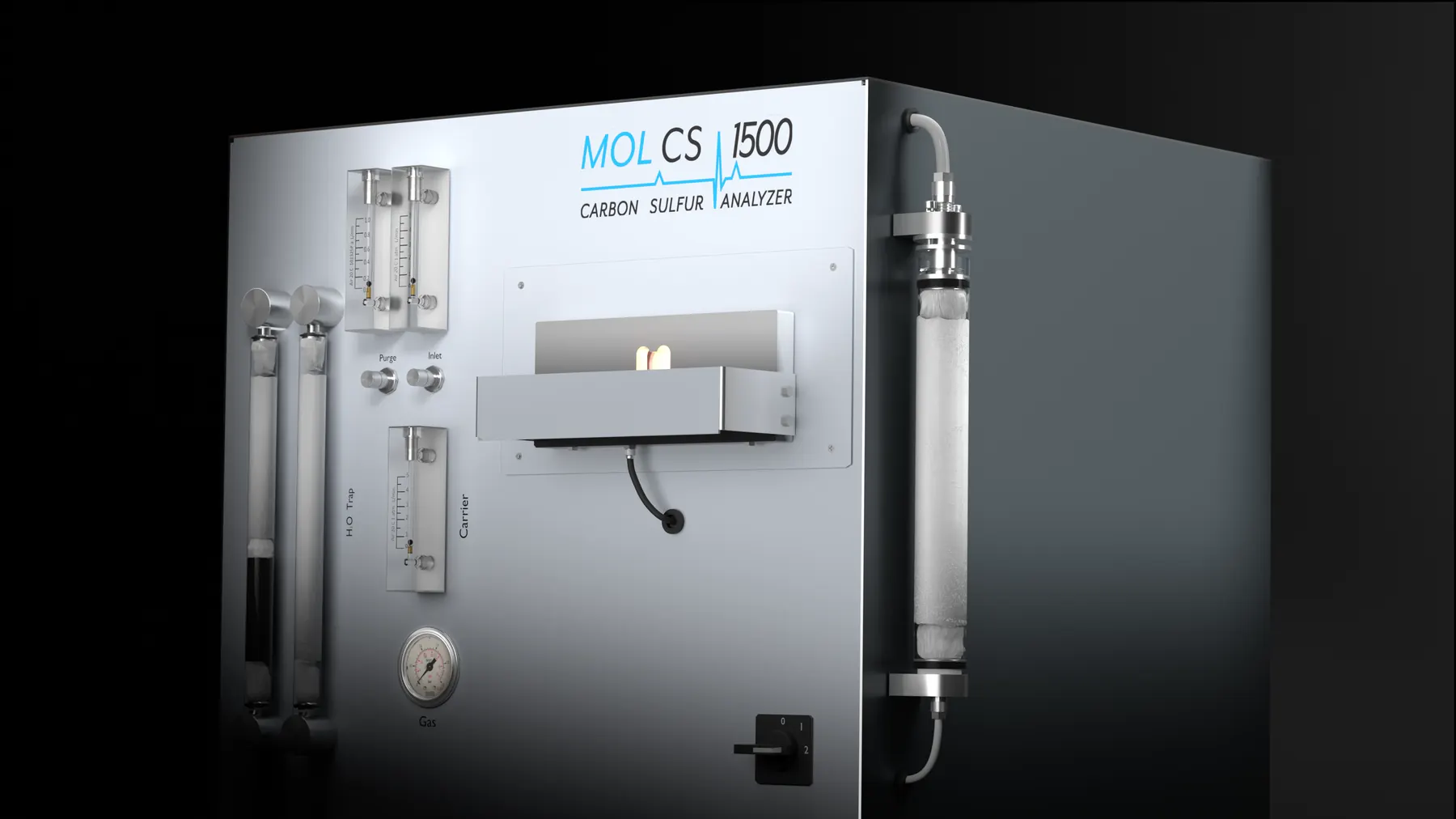
Elemental analyzer
Mol CS1500
Compact, robust and precise. Integrated high-temperature furnace up to 1550 °C, high sample weights, measuring ranges tailored to your samples.
Overview
A high-performance instrument that fits any laboratory.
The Mol CS1500 is a compact and powerful elemental analyzer for determining carbon and sulfur in solid, predominantly organic samples – coal, coke, oil, ash, catalysts, limestone, gypsum, soils, rubber, waste and other solid and even some liquid materials.
With a volume of just under 180 litres it is one of the most compact devices in its class. Despite its space-saving design it delivers high efficiency without compromising comfort or performance – ideal for laboratories with limited available space.
Its low-maintenance and robust construction, the thoughtfully designed Mol control and evaluation software and its high reliability even in rough environments make it a versatile solution for research, industry and production control.
Technical data
Mol CS1500
| Elements | C, S |
|---|---|
| Measuring principle | NDIR |
| Measuring range carbon | 0.025 mg – 500 mg C abs. / up to 100 % C |
| Measuring range sulfur | 0.025 mg – 100 mg S abs. / up to 20 % S |
| Standard sample weight | 350 mg |
| Typical analysis time | 60 – 120 s |
| Furnace type | Resistance furnace, horizontal ceramic tube |
| Furnace temperature | 450 – 1550 °C |
| Temperature resolution | 0.1 °C |
| Sample carrier | Ceramic boat |
| Gas supply | Oxygen 99.5 %, 2 – 4 bar (30 – 60 psi) |
| Chemical reagents | NaOH on carrier (Ascarite), Magnesium perchlorate (Anhydrone) |
| Power supply | 230 V AC ± 10 %, 50/60 Hz, 16 A |
| Dimensions (W × H × D) | 60 × 57 × 55 cm |
| Weight | approx. 80 kg |
| Ambient conditions | 15 – 33 °C, 20 – 80 % RH |
| Peripherals | Monitor, PC, balance |
Measuring ranges based on a 500 mg sample weight. Values may vary depending on sample material and sample weight.
Application data
Measured values, not promises.
Results from our application laboratory in Munich.
| C | 62.098 % ± 0.202 · 0.33 % |
|---|---|
| S | 2.420 % ± 0.006 · 0.26 % |
| Individual measurements | n = 8 |
| Sample weight | 450 mg |
| Instrument used | Mol CS1000 |
Mean value ± Dev. abs. · Dev. rel.
| C | 99.959 % ± 0.291 · 0.29 % |
|---|---|
| Individual measurements | n = 8 |
| Sample weight | 450 mg |
| Instrument used | Mol CS1000 |
Mean value ± Dev. abs. · Dev. rel.
| C | 12.014 % ± 0.017 · 0.14 % |
|---|---|
| Individual measurements | n = 13 |
| Sample weight | 351 mg |
| Instrument used | Mol CS1000 |
Mean value ± Dev. abs. · Dev. rel.
| C | 1.128 % ± 0.023 · 2.04 % |
|---|---|
| S | 0.507 % ± 0.010 · 1.95 % |
| Individual measurements | n = 8 |
| Sample weight | 502 mg |
| Instrument used | Mol CS1000 |
Mean value ± Dev. abs. · Dev. rel.
Frequently asked questions
How does a carbon/sulfur analyzer work?
What is the difference between the Mol CS1000 and the Mol CS1500?
What measuring range do the analyzers cover?
How long does an analysis take?
Resistance furnace or induction furnace – what is the difference?
Which samples can be analyzed?
How large may the sample weight be?
What is the pre-heating furnace for?
Next step
Quote for the CS1500.
Tell us your matrix, concentration range and sample throughput. We will configure the instrument accordingly and send you a quote.